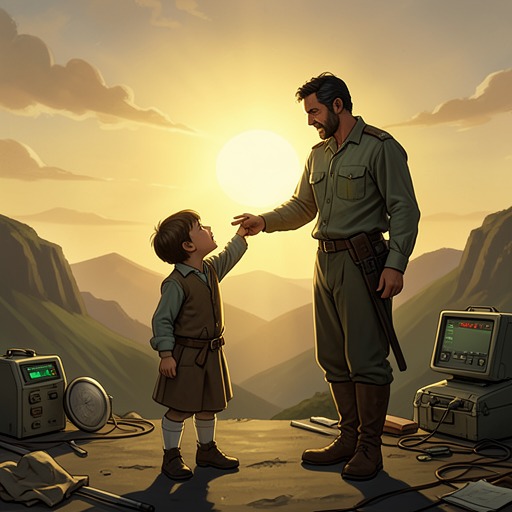
Keng
The DispossessedKeng, the Ambassador from Terra, becomes Shevek’s protector and interlocutor after he escapes the violence in Nio. By offering him asylum and agreeing to transmit his theory beyond A-Io’s control, she makes possible the book’s decisive movement from political refuge to the public sharing of knowledge. Their conversation also reverses the expected comparison between worlds: Keng sees Urras as a near-paradise, while Shevek calls it Hell, and her account of Terra shows what survival has cost her own society.
Identity and Introduction
Keng is the Terran Ambassador on Urras. She first meets Shevek as he reaches the embassy after the Nio demonstration. When he identifies himself as being from Anarres, she recognizes his situation and asks whether he is seeking asylum. She takes him inside and assures him that he is safe on Terran soil and may stay as long as he wants.
Shevek asks to see the Ambassador, not yet knowing that the person caring for him is Keng herself. She introduces herself by name, welcomes him, and tells him to rest; when he cannot decide what to do, he says Takver’s name and confesses his uncertainty. Keng answers by urging him to sleep. The exchange establishes her as a practical host before she becomes a political and philosophical partner in conversation.
Asylum and the Nio Crisis
Keng’s shelter gives Shevek a place apart from the immediate danger following the demonstration. He later explains that his escape depended on people who helped him move through checkpoints: after he reached Old Town, they thought through where he might go, planned how to get him there, and accepted the risks. He names what united their actions as solidarity. Keng’s embassy receives him after that chain of aid, but she does not treat his arrival as an abstract diplomatic matter; she gives him a safe place to recover and speaks with him about what has happened.
Keng is also attentive to the limits of her knowledge. She tells Shevek that she knows little about Anarres because its people have not permitted Terrans to visit, and that she has relied on what Urrasti say about the planet. Her earlier understanding had been that Anarres was an interesting but remote experiment in nonauthoritarian communism. The Nio uprising changes that assessment: she recognizes the demonstrators as inheritors of the same anarchist tradition, opposing power rather than merely demanding better wages or protesting the draft. The government’s panic and the scale of the demonstration become more intelligible to her once she understands that political tradition.
Keng sees a contradiction in A-Io’s decision to bring Shevek to Urras while attempting to keep him away from the populace. Shevek confirms that he had been kept among scholars and the rich, protected from poverty and political unrest so he could do work unavailable to him on Anarres. He believed the government intended to use the completed theory as leverage against other worlds. Their discussion connects his personal refuge to the larger danger of turning scientific knowledge into an instrument of power.
Two Worlds Seen from Outside
Keng’s understanding of Urras is neither simple praise nor denial. She calls it the kindliest, most varied, and most beautiful inhabited world, a place close to Paradise, while acknowledging its injustice, greed, folly, and waste. What distinguishes it for her is that it remains alive—with vitality, achievement, and hope despite its evils. She asks Shevek to consider that a world she admires may appear to him as Hell, and then uses that contrast to explain the distance between their histories.
Her account of Terra is a history of ecological and social catastrophe. Human beings multiplied, consumed resources, and fought until they had ruined the planet and nearly destroyed themselves. The population fell from nine billion to nearly half a billion. Forests disappeared; the air and sky became grey, and the world remained habitable but damaged. Keng contrasts the Odonians’ choice of a desert with Terra’s having made one. The distinction is not that Terrans escaped scarcity, but that their society produced the ruin it must now endure.
Keng says Terra preserved what it could through total centralization: control over land, metal, and fuel; rationing, birth control, euthanasia, and universal labor conscription; and the regimentation of individual life toward survival. The Hainish later helped Terrans leave their damaged world, providing ships and treating them with charity. Yet assistance did not restore Terra’s former abundance. Keng describes Terrans as able to deal with other societies as equals while remaining outsiders to the flourishing world of Urras, which they can admire and perhaps envy. Her history makes survival itself a compromised achievement, not proof that the society that survived has found a desirable way to live.
The Gift of the Theory
Keng’s most consequential decision follows Shevek’s explanation of why he came to her. He rejects the idea that he must sell his work and asks whether giving is possible. He wants his theory shared with Terra, Hain, other worlds, and the countries of Urras, so no one power can turn it into private profit, a weapon, or a means of becoming richer and stronger than its rivals. Keng agrees to help make that possible.
Shevek proposes broadcasting the equations to physicists on Urras and across the other worlds. Keng is more than willing. He explains that the result will amount to only a few pages, while the proofs and implications can take longer and be developed by others if he cannot do so himself. The proposal makes the theory a common resource rather than a possession controlled by A-Io. Keng’s willingness is therefore practical as well as sympathetic: she offers a means to carry out the distribution Shevek wants.
She also offers access to communication with Anarres. Keng says she had not asked whether a message was waiting for him because she had not considered the matter from his point of view. Her government knows the wavelength used by the Anarresti but had not used it, since Anarres had not invited contact. If Shevek wants to speak with home, the embassy can arrange it by relaying through the Hainish ship in orbit around Urras. This restraint contrasts with the political pressure Shevek has experienced elsewhere: Keng offers a connection without claiming a right to impose it.
Relationship and Significance
Keng and Shevek meet as representatives of societies that are both outsiders to Urras in different ways. Shevek is an Anarresti whose work and presence A-Io seeks to manage; Keng is a Terran whose people depend on Hainish assistance after their own planetary collapse. Their exchange is not agreement on every judgment. Shevek sees Urras as Hell, while Keng calls it a living world close to Paradise. The disagreement gives their conversation its force: each must encounter a history the other cannot simply absorb into familiar categories.
Keng admits that she is less alien to Urras than Shevek, but she does not claim to understand him fully. His account of giving, solidarity, and the danger of allowing the Ioti to own his theory leads her to help him share it. When he asks her to help him get home, he refuses the role of an altruist and says that he does not want to die or remain on Urras. He suggests that the Ioti might prefer to make him disappear, since a living absent anarchist could be forgotten more easily than a dead martyr. Keng’s support thus extends from immediate shelter to the possibility of return, though the passage leaves the outcome of that request unresolved.
Through Keng, the encounter broadens the novel’s comparison of political systems beyond a simple opposition between a free society and an oppressive one. Urras can be beautiful and unjust; Terra can survive and remain a ruin; Anarres can offer a tradition of solidarity while remaining difficult for outsiders to know. Keng’s role is to receive Shevek without converting his theory into a claim of ownership, and to help him make its circulation a gift. Their meeting turns the idea of interworld contact into an ethical choice about whether knowledge will reinforce power or be shared.